How to build a quiet memorial shelf for your cat
A 12 lb cat's ashes fit in an urn of about 12 cubic inches[1], small enough for a windowsill or a bookshelf. The harder part is choosing the spot, and making sure the cats you still have don't knock it all to the floor.
By the Cat Cremation Services editorial team · Updated September 24, 2026 · 6 min read · Sources
- Picking a spot that meant something to your cat
- Right-sized urns and a simple layout that works
- Cat-proofing with putty, LED candles and shadow boxes
The short answer
What goes on a cat memorial shelf, and where should it go?
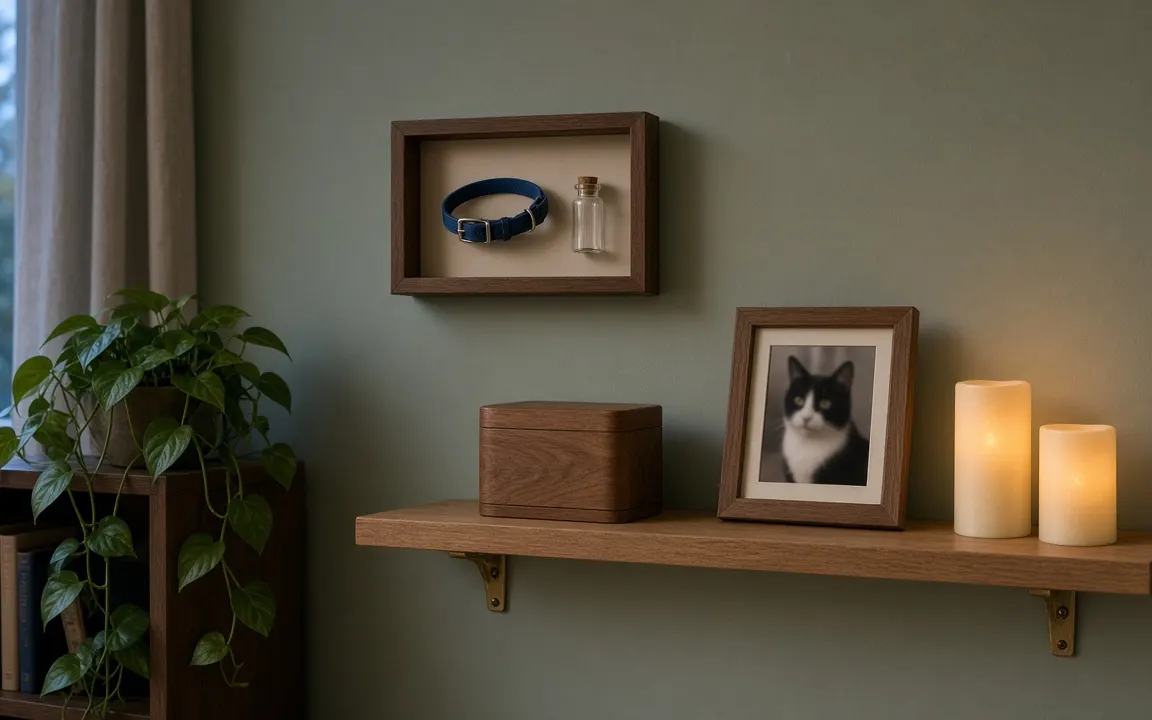
Most cat memorial displays hold four things: a small urn, one favorite photo, the collar and a keepsake such as a whisker vial or paw print. Put them somewhere your cat actually spent time, like a windowsill, a bookshelf near their chair or a wall shelf by the bed. If other cats live with you, fix everything down with museum putty and use flameless candles.
You don't need to set it up before the ashes arrive. Private cremation ashes commonly come back in about 5-10 days[2], which gives you time to find the spot and order an urn if the crematory's container isn't one you want to keep. Our guide to how long cat ashes take to come back explains the usual wait. Some people build the shelf in a single afternoon; others add one object at a time over months.
Location
Choosing the right spot: the sunny sill, the shelf or the bedside
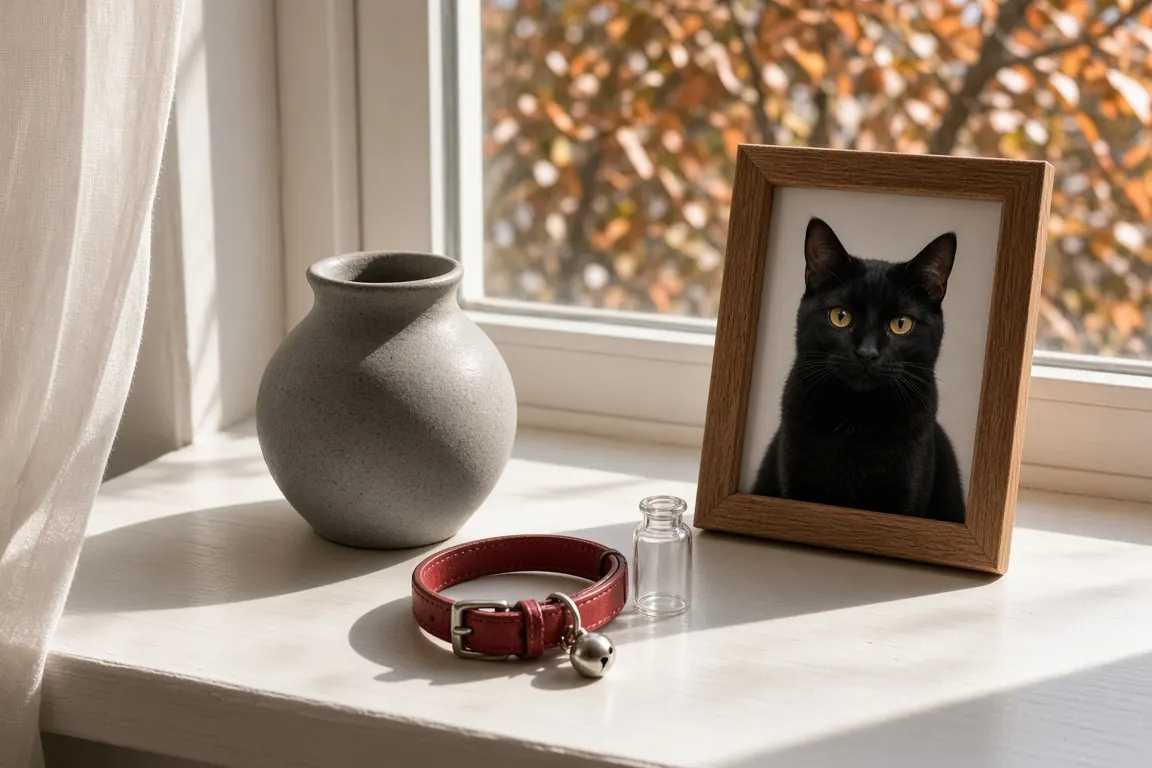
Cats map a home by warm spots and lookouts, so many owners already know where the shelf belongs: the sill where they watched birds, the top of the bookcase they claimed, the corner of the bed. Putting the display there keeps the memory tied to the place rather than hidden in a cupboard.
- Windowsills are lovely but bright. Direct sun fades photos and fur within a season or two. Use a UV-filtering frame and keep fur in a closed box.
- If your surviving cats still use the sill, put the shelf on the wall beside the window instead. That way they keep their lookout and the urn stays safe.
- Avoid kitchens and bathrooms. Steam and cooking grease cloud glass and loosen adhesives.
- Eye level suits a shelf you'll pass daily. A bedside table suits a display you'd rather see only at quiet moments.
In a small apartment, a floating shelf the width of a hardback book is plenty. Our apartment goodbye guide has more on making room for grief in a small home.
The centerpiece
What size urn does a cat need?
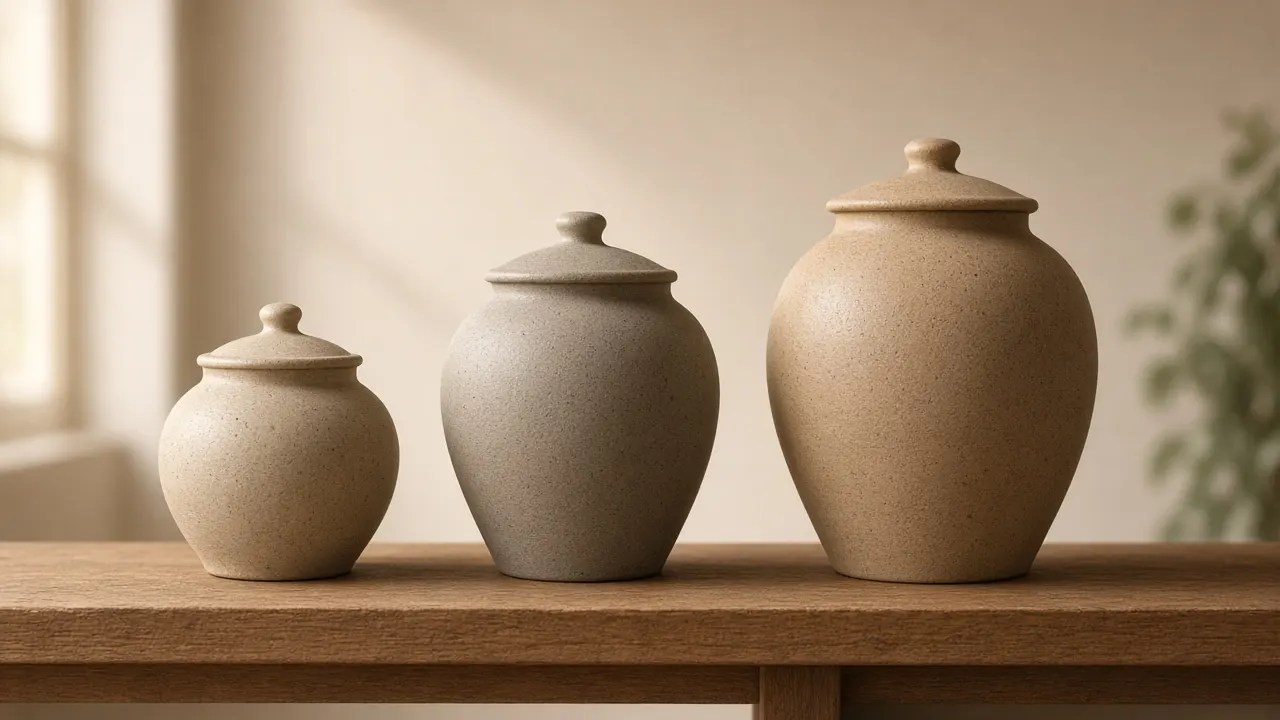
Smaller than you'd guess. Using the industry rule of one cubic inch per pound, a 12 lb cat needs about 12 cubic inches of space, and by our estimate returns roughly 6.7 oz[3] of ash, based on the ratio measured in a study of 100 commercial cremations. Add a little margin, since some crematories return ashes in a bag that takes up room. A 15–20 cubic inch urn covers most house cats; a large Maine Coon may need 25 or more.
Free tool
Urn size calculator
Find the urn volume you need from your pet's weight, plus keepsake and sharing options.
| Style | Typical US price | Shelf notes |
|---|---|---|
| Ceramic urn | $20–$100[4] | Glazed finish is easy to dust; heavier bases resist paws |
| Wooden box or urn | $30–$150[5] | Flat sides take a photo panel; won't shatter if knocked |
| Keepsake mini urn | $15–$60[6] | For a portion only; needs putty, as it's light |
| Name engraving | $15–$25[7] | Name-only; dates usually cost more |
Wood is the forgiving choice in a home with cats, since it survives a fall. Some makers carve cat-shaped urns; one Australian crematory prices a carved wooden cat urn at about A$200[8]. If part of the ashes will go into jewelry or keepsakes for family, size the main urn for what's left. Our article on cat ash keepsakes and jewelry explains how much each piece takes.
Layout
Arranging the urn, photo, collar and whisker vial
A loose triangle is the simplest layout that looks intentional. Put the tallest object, usually the photo, at the back and a little to one side. Set the urn in front of it, slightly off-center. Lay the collar in a gentle curve at the front, bell facing out, and stand the whisker vial or place the paw print in the remaining gap.
- Start with a clean shelf and a runner or small tray, which defines the space and makes dusting easy.
- Place the urn first, then build around it, stepping back to look from across the room.
- Choose one photo that shows your cat's face clearly, rather than several small ones competing.
- Leave some empty space. A crowded shelf reads as storage; a sparse one reads as a memorial.
If you haven't collected whiskers, fur or prints yet, some of those can still be found around the house. Our guide to cat keepsakes without ashes explains what's still possible and how to store it.
Cats and shelves
Cat-proofing the display: putty, shadow boxes and safe light
Cats push things off shelves. It's partly curiosity and partly play, and a grieving cat looking for a missing companion may be extra drawn to a shelf that smells of them. Plan for it rather than hope.
- Museum putty or museum gel under the urn, frame and vial. It holds firmly but peels off without marking wood.
- A shelf with a raised front lip, or a glass-fronted cabinet if your cats are determined.
- Screw or tape the urn's base panel closed, so a fall can't spill ashes.
- A shadow box on the wall for the lightest items: collar, whisker vial, fur and a paw print. A box one and a half to two inches deep holds a collar comfortably, and nothing can be batted off.
Warm white light, set to switch on at dusk, turns the shelf into a small evening ritual without any risk. Choose candles with a sealed battery compartment so a curious cat can't get at the batteries.
The cats still with you
How other cats react to the memorial shelf
Some surviving cats ignore the display entirely. Others sniff the collar for days, sleep beside the urn or sit on the shelf as if keeping watch. Both are normal, and there's no need to shoo a cat away unless something is about to fall. The collar and blanket carry the scent they're searching for.
If you have more than one cat, did the others see the cat who died?
Tap an answer to vote and see how others answered. Anonymous.
If a cat seems distressed near the shelf, moving the most scented items into a shadow box often calms things. Changes in eating, hiding or litter habits deserve more attention; our guide to loss in multi-cat households explains what to watch for and when to call the vet.
Months and years later
When to change or pare down the display over time
A memorial shelf doesn't have to stay as it was on day one. Grief has its own timetable: in one study of pet owners, nearly 1 in 3[9] were still grieving six months later. Many people keep the full display through that first stretch, then gradually simplify it. The RSPCA's pet bereavement toolkit has more on living with grief over the longer term.
- Add pieces as they arrive, such as a clay paw print or an engraved stone from a maker.
- Swap the photo on their birthday or adoption day; it keeps the shelf feeling alive.
- Move the urn if a new cat arrives and starts using the sill. It isn't disloyal; your old cat would have defended that spot too.
- Pare down to one object when the full shelf starts to feel heavy rather than comforting.
Changing a memorial isn't forgetting. It's letting the memory move in with the rest of your life.
The memorial budget planner helps you price an urn, frame and shadow box together, and our cat memorial ideas cover memorials beyond the shelf. If it's hard to look at the shelf months on, grief after losing a cat may help. Still arranging cremation? Share a few details and we'll email private options near you.
Free tool
Memorial budget planner
Add up cremation, urn, keepsakes and a farewell so the total holds no surprises.

Reader polls
What would you choose?
Vote anonymously and see how other readers answered. The results are live counts from people who visit this site, so they show real opinions, not a scientific sample.
If you have more than one cat, did the others see the cat who died?
Tap an answer to vote and see how others answered. Anonymous.
Where are (or will be) your pet's ashes?
Tap an answer to vote and see how others answered. Anonymous.
Do you keep more than one memorial for the same pet?
Tap an answer to vote and see how others answered. Anonymous.
Questions people ask
Is it okay to keep my cat's ashes in the bedroom?
Yes. There's no health or practical reason not to keep a sealed urn in a bedroom, and many people find it comforting to have their cat near where they slept. If it disturbs your sleep or makes the room feel heavy, a hallway or living-room shelf is just as fitting. You can always move it later.
How do I stop my cat from knocking the urn off the shelf?
Anchor it with museum putty or museum gel, which grips firmly and peels off cleanly. Choose a heavier ceramic or a wooden urn over a light metal one, and keep the shelf lip-edged or behind glass if your cat is persistent. Close the urn's base securely so nothing spills even if it does fall.
What size shadow box do I need for a cat collar and keepsakes?
A deep frame about 8 by 10 inches and one and a half to two inches deep fits a collar, a whisker vial, a small photo and a paw print. Choose acid-free backing and UV-filtering glass if it will hang in daylight. Pin items with fabric pins or archival mounting strips rather than glue.
Can I display my cat's ashes in the crematory's temporary container?
You can, and some temporary containers are perfectly presentable. Many are plain plastic or cardboard, though, so owners often move the sealed bag inside into a chosen urn later. There's no rush; the ashes are safe in the original container until you find something you like.
Should the memorial shelf include my other pets who have died?
Many homes end up with a shared shelf for several animals over the years, and that can feel warm rather than crowded. Give each pet a distinct grouping, with their own photo and urn, and keep the layout simple. A small engraved tag on each urn helps family members know who is who later.
Keep reading

Urn size calculator
Work out the right urn size from your cat's weight.

Whiskers, fur and paw prints
The keepsakes that finish a memorial shelf, and how to save them.
Loss in multi-cat homes
How surviving cats grieve and what helps them settle.

Ask about private cremation
We'll email local options that return your cat's ashes.
Sources and our estimates
- [1] Using the industry rule of thumb of 1 cubic inch of urn space per pound of body weight, a 12 lb cat needs an urn of about 12 cubic inches; a 70 lb dog needs about 70 cubic inches. Our estimate: urn cu in = body weight lb x 1 (industry rule of thumb, not a measured value). How we calculate.
- [2] A US aftercare guide says many families receive private cremation ashes within about one to two weeks, with 5-10 days commonly quoted. Funeral.com - Pet Cremation Timelines: How Long Until Ashes Are Returned, 2026.
- [3] A 12 lb cat would be expected to return about 6.7 oz (0.42 lb) of cremated remains. Our estimate: 12 lb x 3.5% x 16 oz/lb. How we calculate.
- [4] Memorials.com puts ceramic pet urns at $20–$100. Memorials.com – Pet Urn Cost Guide, 2025.
- [5] Memorials.com puts wooden pet urns at $30–$150. Memorials.com – Pet Urn Cost Guide, 2025.
- [6] Keepsake or mini pet urns cost about $15–$60, versus $25–$100 for small and $40–$200 for medium urns (Memorials.com). Memorials.com – Pet Urn Cost Guide, 2025.
- [7] Simple name-only engraving on a pet urn typically adds $15–$25; name plus dates adds $25–$40. Memorials.com – Pet Urn Cost Guide, 2025.
- [8] Brisbane pet crematory Patch & Purr sells pet urns and timber boxes from A$95 (white ceramic) to A$200 (carved wooden cat). Patch & Purr Pet Cremations – Urns & timber boxes, 2026.
- [9] A 2009 Bulletin of the Menninger Clinic study of 106 pet owners found nearly 1 in 3 grieved for at least six months. SHRM — Grieving a Pet's Death: Should Workers Get Time Off? (2016), 2009.
Get private cremation quotes for your cat
Tell us what you need and where you are. We'll reply by email with clear options and prices so you can decide in your own time.