What size urn does your cat need?
Most cats need an urn of just 10 to 20 cubic inches, about the size of a large mug. Enter your cat's weight and we'll size the urn, plus any keepsakes, for you.
- Urn volume in cubic inches and mL
- Room for keepsakes and family shares
- Sized for cats, from Singapura to Maine Coon
Urn size calculator
Enter your pet's healthy adult weight. We size the urn using the industry rule of 1 cubic inch per pound, plus 10% room to spare.
Recommended urn size
11 cu in (180 mL)
Look for: Small (up to 20 cu in)
| Total ashes (by volume) | 10 cu in (164 mL) |
|---|---|
| Expected ash weight | 4.8 oz–8 oz |
| Urn with 10% margin | 11 cu in (180 mL) |
Standard sizes: small up to 20, medium up to 60, large up to 120 and extra large 200+ cubic inches. If you're between sizes, choose the larger one.
Source: Embrace Pet Insurance - Bury or Cremate Your Dog? Costs, Pros & Cons; Our estimate. 1 cu in per lb is an industry rule of thumb
Next step: Find urns and prices near you →
Using the calculator
Sizing a cat urn in three quick steps
- Enter your cat's weight at their healthy adult size, not their weight at the end of an illness. A cat who fell from 12 lb to 8 lb with kidney disease still has the bones of a 12 lb cat, and bone is what becomes ash.
- Choose how many households will share the ashes, from one to eight. The calculator sizes one urn per household.
- Tick the keepsake box if each household also wants a small keepsake urn of about 3 cubic inches, and the calculator sets that aside first.
The result gives each urn's volume in cubic inches and milliliters, with a suggested standard size, and shows how much goes into keepsakes. If you haven't decided on cremation yet, the cat cremation services page explains which options return ashes.
The method
The simple rule behind the urn calculator
Urn makers use a long-standing rule of thumb: allow one cubic inch of urn space for every pound of body weight. We add a 10% margin, because cremated remains settle unevenly and it's frustrating to find an urn a little too small. Then we match that volume to a standard size band: small (about 20 cubic inches), medium (60), large (120) and extra-large (200 and up).
12 cu in (cat); 70 cu in (dog)[1]
Why does the rule work? Cremated remains typically weigh about 3-5% of body weight[2], and they're fairly dense. By our estimate, based on the 3.5%-of-body-weight ratio in a study of 100 commercial cremations, a 12 lb cat returns around 6.7 oz[3]. The volume rule deliberately overshoots that a little, which leaves space for the bag the ashes come in.
A worked example
Example: a 15 lb Maine Coon, kept whole or shared three ways
Maine Coons are the heavyweights of the cat world, and owners often assume they'll need a dog-sized urn. Here's what the calculator shows for a 15 lb Maine Coon, first kept in one urn and then shared between three households who each want a keepsake urn too.
| Scenario | Calculation | Result |
|---|---|---|
| One household, no keepsakes | 15 cu in + 10% margin (16.5) | About 17 cu in (270 mL): a small urn |
| Three households, keepsake urn each | 3 × 3 cu in set aside first | 9 cu in in keepsake urns |
| What's left, split three ways | 6 cu in ÷ 3, + 10% margin | About 2.2 cu in (36 mL) per household |
So even a big cat needs only a small urn, and once the ashes are shared each household's portion fits a keepsake-sized container. Many families are relieved by that: the urn can sit on a bookshelf or windowsill rather than needing its own table. This calculator only plans keepsake urns; a pendant holds about 0.05 cubic inches, a pinch from any share, and the ashes sharing planner handles pendants, rings and scattering tubes.
After you have a size
Choosing an urn once you know the size
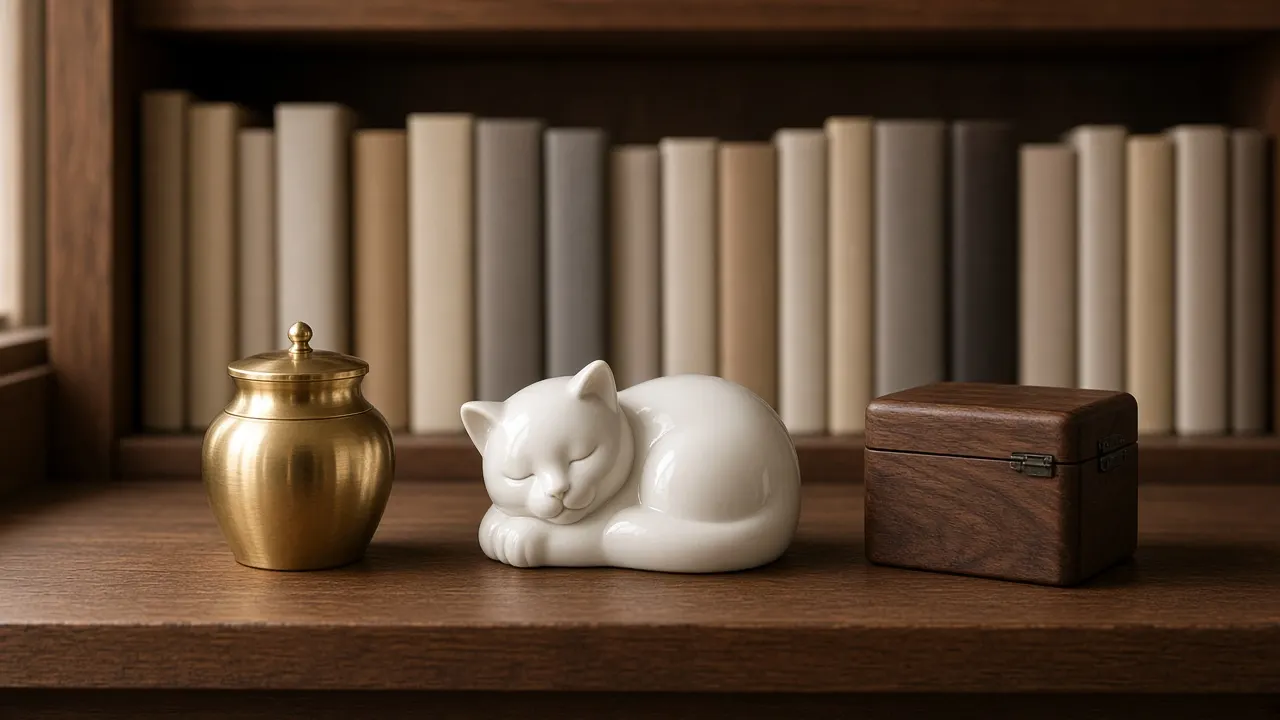
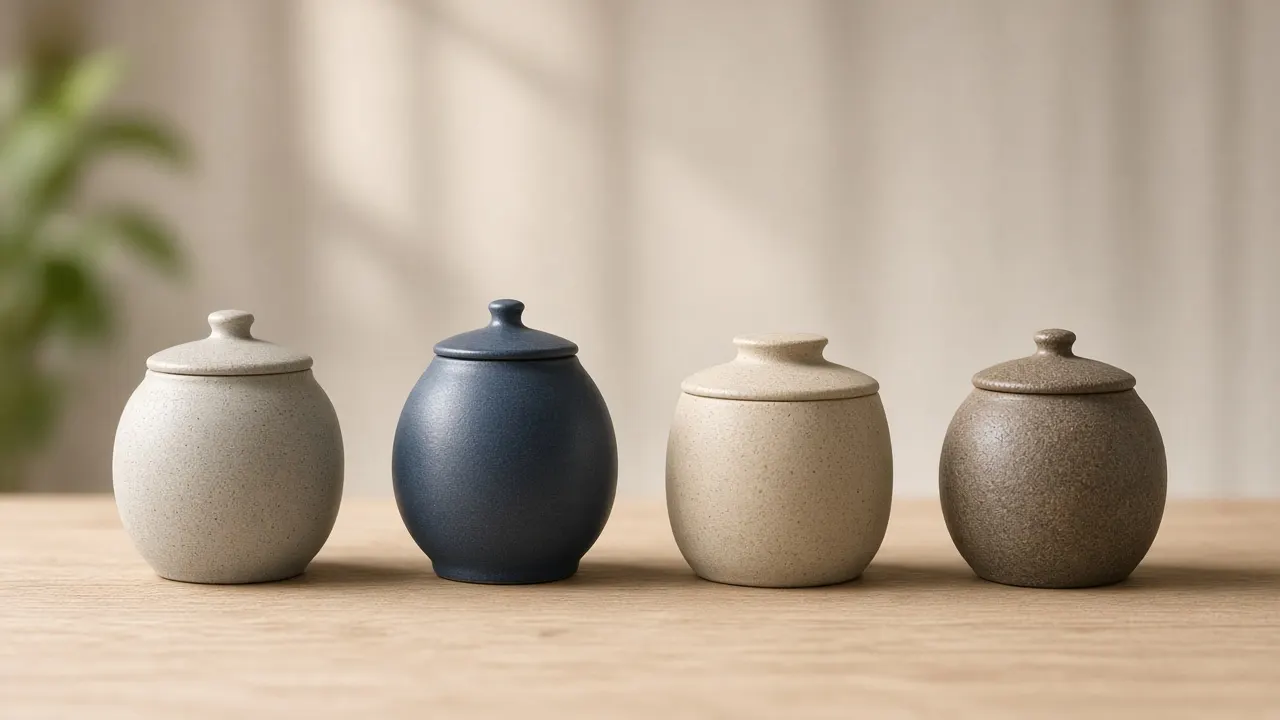
With the volume in hand, the choice becomes about style and budget. One industry report puts personalized pet urns at about $50 to more than $1,000[4], so there's room for almost any budget. For cats, popular styles include wooden boxes with a photo frame, ceramic urns shaped like a sleeping cat, and small brass urns with an engraved name.
- Check the listed capacity, not just the dimensions. Some decorative urns have thick walls and hold less than they look.
- Consider how the ashes go in. Base-loading urns with a screw plate are easier than top-loading ones with a narrow neck.
- Think about where it will sit. A windowsill urn in the sun should be ceramic, stone or metal rather than a photo-print finish that fades.
If you'd rather plant the ashes or scatter them, you may not need a permanent urn at all. Our guide to building a quiet memorial shelf has ideas for displaying a small urn alongside a collar, photo or whisker vial.
Which small keepsake would mean the most from your cat?
Tap an answer to vote and see how others answered. Anonymous.
Know the limits
What the urn size calculator can't know
Real ash volume varies with bone density, age and the cremation process. Very old or very young cats may return less than the rule suggests; large, big-boned cats may return a little more. Water cremation usually returns somewhat more material than flame cremation; the Veterinary Sustainability Alliance's aquamation overview describes how that process works. The 10% margin covers most of that, but not every case.
If you're choosing a very snug urn, ask the crematorium roughly how much they returned, or wait until the ashes are home before ordering an engraved one. For a closer look at weight rather than volume, try the ashes weight estimator.
Free tool
Ashes weight estimator
See roughly how much ash to expect back, by species and body weight.
What to do next
Next steps once your urn is sized
Most crematoriums return a cat's ashes in a simple container or scatter tube, so you don't need to buy an urn before the cremation. If you do want the provider to supply one, ask for its capacity and the price difference. For ideas beyond urns, browse keepsakes and jewelry after cat cremation and memorial ideas for cats. If you're curious how the ashes are prepared, what happens during cat cremation walks through it.
If you still need to arrange the cremation, tell us your town and your cat's weight and we'll email options that include private cremation with ashes returned.

Reader polls
What would you choose?
Vote anonymously and see how other readers answered. The results are live counts from people who visit this site, so they show real opinions, not a scientific sample.
Which small keepsake would mean the most from your cat?
Tap an answer to vote and see how others answered. Anonymous.
Where are (or will be) your pet's ashes?
Tap an answer to vote and see how others answered. Anonymous.
How much would you spend on a memorial item, beyond the cremation itself?
Tap an answer to vote and see how others answered. Anonymous.

Free tools to help you plan
Urn size calculator
Find the urn volume you need from your pet's weight, plus keepsake and sharing options.
Ashes weight estimator
See roughly how much ash to expect back, by species and body weight.
Ashes sharing planner
Split ashes fairly between family members, keepsake urns and jewelry.
Questions people ask
Can I use a dog urn for my cat?
You can, but most dog urns are much bigger than a cat needs, which can make them look half-empty and harder to place. A small urn of 20 to 25 cubic inches suits nearly every cat. If you love a particular larger design, add a small photo, collar or letter inside to fill the space.
How many milliliters is a cat urn?
One cubic inch is about 16.4 mL. A 10 lb cat with the 10% margin needs about 11 cubic inches, or roughly 180 mL, which is less than a standard coffee mug. A 15 lb cat needs about 270 mL. Always check the urn's listed capacity rather than its outside measurements.
Should I use my cat's weight before or after illness?
Use their healthy adult weight. Cats with kidney disease, hyperthyroidism or cancer often lose a lot of muscle and fat, but their skeleton stays the same size, and bone is what becomes ashes. Using the lower weight could leave you with an urn that's slightly too small.
What size keepsake urn holds some of a cat's ashes?
Keepsake mini urns usually hold 1 to 3 cubic inches, enough for a meaningful portion of a cat's ashes. Pendants hold much less, about a pinch. If several people want keepsakes, set the number of people and tick the keepsake box so each main urn is sized for what's left.


Sources and our estimates
- [1] Using the industry rule of thumb of 1 cubic inch of urn space per pound of body weight, a 12 lb cat needs an urn of about 12 cubic inches; a 70 lb dog needs about 70 cubic inches. Our estimate: urn cu in = body weight lb x 1 (industry rule of thumb, not a measured value). How we calculate.
- [2] Embrace notes cremated remains typically weigh about 3-5% of the pet's original body weight. Embrace Pet Insurance - Bury or Cremate Your Dog? Costs, Pros & Cons, 2025.
- [3] A 12 lb cat would be expected to return about 6.7 oz (0.42 lb) of cremated remains. Our estimate: 12 lb x 3.5% x 16 oz/lb. How we calculate.
- [4] Personalized pet urns range from about USD 50 to more than USD 1,000. Astute Analytica via GlobeNewswire — Global Pet Preservation Services Market to Hit USD 112.7 Million by 2032 (Apr 2, 2024), 2024.
Find a cat cremation provider near you
Tell us what you need and where you are. We'll reply by email with clear options and prices so you can decide in your own time.