How to tell your child the cat has died, gently and honestly
In a UK survey, 93.4%[1] of parents said they wanted better guidance on helping children through a pet's death. Here's what to say, and what to skip.
By the Cat Cremation Services editorial team · Updated September 24, 2026 · 6 min read · Sources
- Plain words for every age, from toddlers to teens
- Rituals children can lead themselves
- Aftercare options sent by email, so you can focus on your family
The short answer
How do you tell a child their cat has died?
Tell them soon, in a quiet place, using the word "died" and one short true reason, such as "Milo's kidneys stopped working and his body couldn't keep going." Then stop and let them react. Children cope far better with a sad truth delivered kindly than with a vague story they have to decode later.
It's fine to cry in front of them. Seeing you sad shows them that grief is a normal response to losing someone you love, and it gives them permission to feel it too. You don't need perfect answers, and "I don't know, but I'll find out" is a perfectly good one.
Cats are in about 39%[2] of US households, according to the American Pet Products Association, so for many children the family cat is their first experience of death. How that first loss is handled shapes how they approach harder ones later, which is a good reason to take it seriously without making it frightening.
Careful with euphemisms
Why "put to sleep" and "ran away" can backfire
Adults use soft phrases to protect children, but young kids take words literally. A four-year-old told the cat was "put to sleep" may become afraid of bedtime, or of an anesthetic before a tonsil operation. "We lost Luna" can send a child searching the garden. "She went away" leaves them wondering what they did to make her leave.
Cats create a particular trap because they sometimes do wander off. If your cat was indoor-outdoor, it can be tempting to say she didn't come home. But children hold on to hope for months, checking the window and the cat flap, and finding out the truth later tends to hurt twice.
Age by age
What children understand at each age, and what to say
Children understand death in stages. These are rough guides, and your own child may be ahead of or behind them. Match the amount of detail to the questions they actually ask.
| Age | What they usually understand | What helps |
|---|---|---|
| Under 3 | Notices the cat is gone and that you're sad, but not what death means | Keep routines steady, give extra cuddles, use simple words: "Tiger died. We miss him." |
| 3 to 5 | May think death is temporary or reversible; asks the same question many times | Repeat the same simple answer patiently. Explain that dead means the body stopped working and can't start again. |
| 6 to 9 | Knows death is permanent; may worry it was their fault or that others will die | Say clearly that nothing they did or thought caused it. Invite questions about what happens next. |
| 10 to 12 | Understands fully; may want facts about the illness or the cremation | Answer honestly and in detail if asked. Include them in some decisions. |
| Teenagers | Adult understanding, but may hide grief or grieve privately | Give space, check in quietly, and don't assume that silence means they're fine. |
Younger children often grieve in bursts: sobbing one minute, asking for a snack the next. That isn't a lack of feeling. Small children can only hold big emotions for short stretches, and play is how they work through them.
Being there
Should children be at the euthanasia, or see the cat afterward?
There's no single right answer. Many children over about six cope well with being present if they're prepared, and some find it much easier than imagining what happened. Younger children often do better saying goodbye beforehand, then seeing the cat afterward, looking peaceful on a blanket.
If a child is going to be there, tell them what they'll see. The vet usually gives a sedative first, so the cat relaxes and may seem asleep. Afterward, a cat's eyes often stay slightly open, and there may be a twitch or a deep breath that's a reflex, not pain. A child who knows this in advance is far less likely to be frightened.
A home visit can make this easier on the whole family, because your cat stays in a familiar place and children can come and go. In the US, CareCredit's 2025 figures put a cat's euthanasia at about $158 in a clinic and $359 at home[3]. Our article on coordinating with your vet explains how to set up a home visit.
Where would you prefer your pet's final moments to happen?
Tap an answer to vote and see how others answered. Anonymous.
Something to do
Small rituals that children can lead
Children feel better when they can do something. A small ritual gives their feelings a shape and gives the family a moment to remember the cat together. Let your child choose, and let it be as simple or as silly as they want.
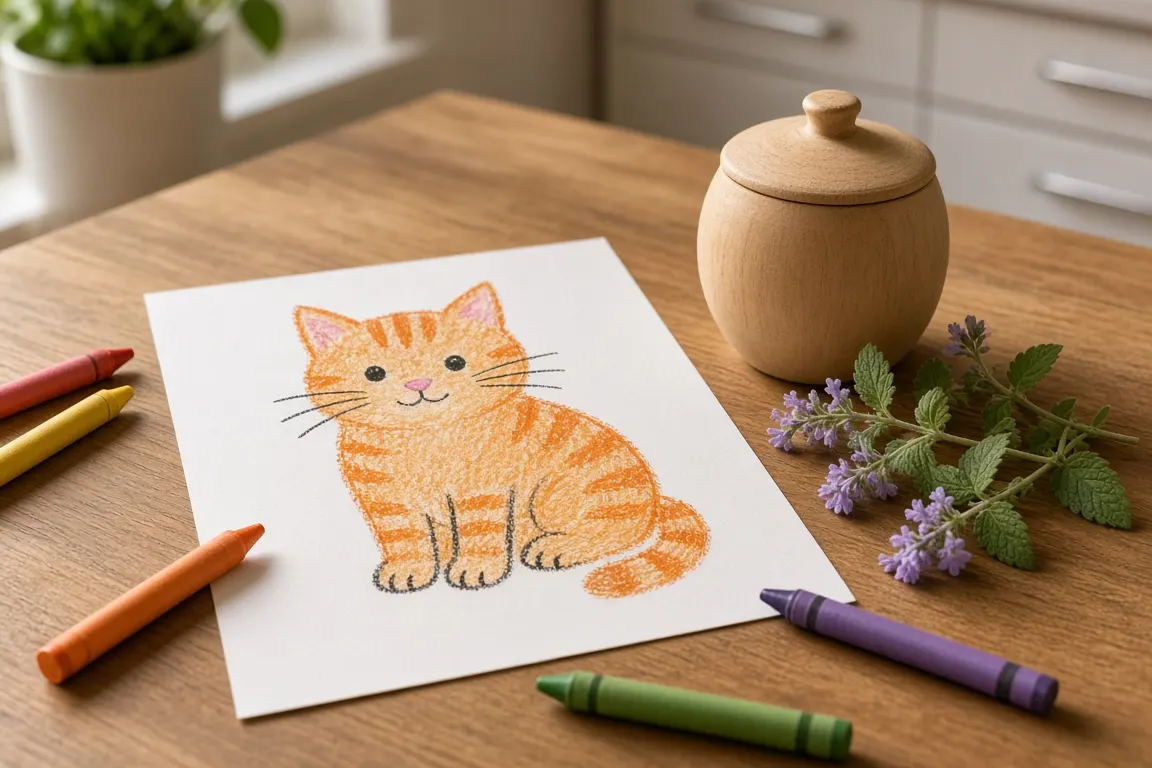
- A letter or drawing that goes with the cat. Many crematoriums will let a small paper note travel with your cat. Ask before collection, and keep a photo of it.
- A favorite toy tucked in the blanket. A feather wand or a crinkle ball can go too, though some providers ask that plastic or metal items stay home.
- Planting catmint. A pot of catmint or cat grass on a sunny step is something a child can water and watch grow. If you mix in any ashes, remember they're very alkaline, around pH 11.7[4], so the soil needs amending and time to settle first, often 90–120 days[5].
- A memory jar. Each family member writes down funny or sweet cat moments on slips of paper. Read them together on a hard evening.
- A paw print. Clay kits cost very little, and some crematoriums add a clay paw impression for about $10[6]. Ask before your cat is collected.
What would you send with your cat to cremation?
Tap an answer to vote and see how others answered. Anonymous.
The farewell planner helps you sketch a simple goodbye, including who will be there and what will go with your cat, so nothing gets forgotten on a difficult day. For more ideas, see memorial ideas for cats and our guide to keepsakes like whiskers and fur.

Free tool
Farewell & memorial service planner
Build a simple goodbye: who, where, readings, rituals and a checklist.
Tricky questions
Answering children's questions about cremation
School-age children often want to know exactly what happens. Keep it calm and factual: "Cremation uses a lot of heat to turn the body into soft ashes. Milo can't feel anything anymore, so it doesn't hurt him." Most kids accept that more easily than adults expect.
They may also be surprised by how little comes back. By our estimate, a 12 lb cat returns only about 6.7 oz[7] of ashes, around a teacup's worth. Some children like choosing a small urn or holding the box. If they ask whether the ashes are really their cat's, you can explain the difference between private and communal cremation; what happens during cat cremation walks through each step in plain words.
Beyond home
Letting school and other adults know
Send a short note to your child's teacher. Something like "Our cat Pepper died on Tuesday and Sam is quite upset" is enough. Teachers see a lot of children grieving pets, and knowing lets them understand a quiet day, a tearful moment in reading time or a sudden drawing of a cat.
Children sometimes hear the same dismissive comments adults do. In the RSPCA's pet bereavement survey, 34.5%[8] of bereaved owners had been told their loss was just a pet. Let your child know that their sadness is real and that it's fine to tell a friend or teacher they miss their cat.
Watching over them
When a child's grief needs more help
Most children's grief eases over weeks, with flashes of sadness for months. Look for signs that it's stuck: trouble sleeping or nightmares lasting weeks, refusing school, going back to much younger behavior, intense fear that you or other pets will die, or a lot of blame aimed at themselves or at the vet.
If you see those, talk to your pediatrician or school counselor. The free pet loss helplines at Tufts and Cornell also speak with parents[9], the RSPCA's bereavement toolkit has a section on supporting children, and our article on grief after losing a cat covers your own grief, which matters too.
If you'd like one less thing to organize, tell us about your cat. We'll email local cremation options and prices, and you can browse aftercare services whenever you have a quiet moment.

Reader polls
What would you choose?
Vote anonymously and see how other readers answered. The results are live counts from people who visit this site, so they show real opinions, not a scientific sample.
What would you send with your cat to cremation?
Tap an answer to vote and see how others answered. Anonymous.
Where would you prefer your pet's final moments to happen?
Tap an answer to vote and see how others answered. Anonymous.
What helped you most in the first weeks?
Tap an answer to vote and see how others answered. Anonymous.

Free tools to help you plan
Farewell & memorial service planner
Build a simple goodbye: who, where, readings, rituals and a checklist.

Pet loss grief check-in
A private, two-minute check-in on how you're coping, with ideas that match where you are.

Urn size calculator
Find the urn volume you need from your pet's weight, plus keepsake and sharing options.
Questions people ask
Should I wait until after school or the weekend to tell my child?
It's usually kinder to tell them the same day, at a calm moment when you can stay with them afterward. Children notice when a cat is missing and when you're upset, and delays can make them feel shut out. Avoid telling them right before school or bed if you can, so they have time to ask questions.
Is it okay to say the cat went to heaven?
If it fits your family's beliefs, yes. Pair it with a clear statement that the cat died and won't come back, so a young child doesn't imagine a place the cat might return from. If you're not religious, it's fine to say that people believe different things and ask your child what they think.
My toddler keeps asking when the cat is coming home. Is that normal?
Yes. Children under five often don't yet understand that death is permanent, so they ask again and again. Answer patiently with the same short words each time, such as "Luna died, so she can't come home. We miss her." Repetition is how they learn it, not a sign you explained it badly.
Should we get a new kitten straight away to cheer the kids up?
It's usually better to wait a few weeks. A kitten brought home too quickly can teach children that loved ones are easily replaced, and it can make the new cat a target for mixed feelings. Let your family grieve first, then involve the children in choosing when they're ready.
Can my child put something in with our cat for cremation?
Often, yes. Many providers allow a letter, drawing or small soft toy to go with a cat, but rules vary, and some ask that metal or plastic items stay out. Ask when you arrange collection. If an item can't go, your child can keep it beside the urn when the ashes come home.
How do I explain euthanasia without making my child scared of vets?
Explain that the vet's job is to help animals, and that when a cat is very ill and can't get better, the kindest help is a peaceful death without pain. Make it clear that this only happens when an animal can't be made well, never for a cold or an ordinary check-up.


Sources and our estimates
- [1] 93.4% of parents in the RSPCA survey wanted better guidance on helping children through pet loss. RSPCA — Pet Loss Survey Results, 2026.
- [2] 39% of US households own a cat, which is about 53 million households. American Pet Products Association (APPA) 2025 State of the Industry, 2025.
- [3] CareCredit's 2025 study put US cat euthanasia at $158 in clinic and $359 at home, cat cremation at $180 and cat cemetery burial at $566. CareCredit (Synchrony) - Cat Euthanasia: Understanding Your Options and Costs (2025 ASQ360 procedural cost study), 2025.
- [4] Cremated remains have a very high pH of approximately 11.7, which is toxic to plants without amendment. Larkspur Conservation — Giving Cremated Remains a New Life Through Science, 2024.
- [5] Gardening Know How advises letting an ash/soil-amendment mixture sit for at least 90 to 120 days before planting. Gardening Know How — Planting With Cremains: Is There a Safe Way to Bury Ashes, 2024.
- [6] Memorial add-ons at A Greener Place: $15 laser-engraved paw print, $10 clay paw impression, $10 nose print, $5 fur clipping. A Greener Place Pet Aquamation – Pricing, 2026.
- [7] A 12 lb cat would be expected to return about 6.7 oz (0.42 lb) of cremated remains. Our estimate: 12 lb x 3.5% x 16 oz/lb. How we calculate.
- [8] 34.5% of bereaved pet owners were told 'it's just a pet'. RSPCA — Pet Loss Survey Results, 2026.
- [9] Tufts University's Pet Loss Support Helpline (508-839-7966) is free and volunteer-staffed, 6–9 pm ET Monday to Thursday, with 24-hour voicemail. Tufts Cummings School of Veterinary Medicine, 2026.
Arrange your cat's aftercare without the phone calls
Tell us what you need and where you are. We'll reply by email with clear options and prices so you can decide in your own time.